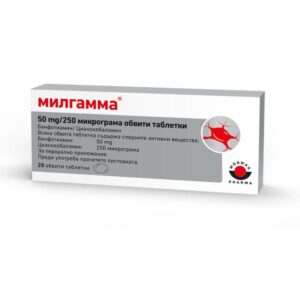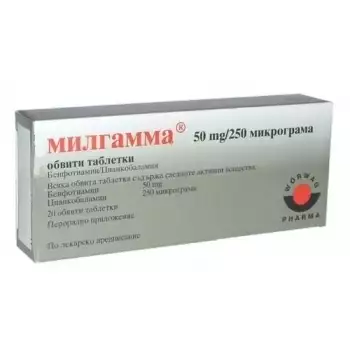
MILGAMA 50/250 mg X 100 tab.
MILGAMA TABLE. / MILGAMMA TABL.x 50 readings:
Neurological diseases of various origins, neuropathies and polyneuropathies (diabetic, alcoholic), neuralgias, neuritis, herpes zoster, facial paresis, myocardial damage, rheumatic complaints, muscle pain, during periods of recovery of the body.
Dosage and administration:
Take 1 dragee 4 times a day, without chewing. In milder cases and during the convalescence period, 1-2 dragees daily.
Composition:
One coated tablet contains: Benfotiamine 50 mg and Cyanocobalamin 250 mcg.
PACKAGE LEAFLET: INFORMATION FOR THE USER MILGAMMA 50 mg / 250 micrograms coated tablets milgamma 50 mg / 250 micrograms coated tablets Benfotiamine (Vitamin B1) / Cyanocobalamin (Vitamin B12) Benfotiamine(Vitamin B1) / Cyanocobalamine (Vitamin B12) Read all of this leaflet carefully before you start taking this medicine because it contains important information for you. – Keep this leaflet. You may need to read it again. – If you have any further questions, ask your doctor or pharmacist. – This medicine has been prescribed for you personally. Do not pass it on to other people. It may harm them, even if their signs of illness are the same as yours. – If you get any side effects, tell your doctor or pharmacist. This also includes any possible side effects not listed in this leaflet. See section 4. What this leaflet contains: 1. What Milgamma coated tablets are and what they are used for 2. What you need to know before you take Milgamma coated tablets 3. How to take Milgamma coated tablets 4. Possible side effects 5. How to store Milgamma coated tablets 6. Contents of the pack and other information 1. WHAT MILGAMMA COATED TABLETS ARE AND WHAT IT IS USED FOR Milgamma coated tablets are a medicinal product that contains benfotiamine (a lipid-soluble form of Vitamin B1) and cyanocobalamin (Vitamin B12). Milgamma coated tablets contain 50 mg benfotiamine and 250 micrograms cyanocobalamin for oral administration. Milgamma coated tablets are a medicinal product for the treatment of neuritis, neuralgia and rheumatic diseases. Milgamma coated tablets are used in adults. Milgamma coated tablets are used for: neurological diseases of various origins, neuropathies and polyneuropathies (diabetic, alcoholic, etc.), neuralgia, inflammation of the nerve (neuritis), herpes zoster, facial paresis (facial paresis), damage to the heart muscle due to vitamin B1 deficiency; rheumatic complaints, muscle pain; for symptoms of severe stress and during the period of convalescence (recovery of the body). If after 28 days you do not feel better or your condition worsens, you should seek medical help. 2. WHAT YOU NEED TO KNOW BEFORE YOU TAKE MILGAMMA COATED TABLETS Do not take Milgamma coated tablets: – if you are allergic to the active substances or any of the other ingredients of this medicine (listed in section 6); – in case of intestinal obstruction (ileus). Warnings and precautions Talk to your doctor or pharmacist before taking Milgamma coated tablets. Due to the castor oil content, vomiting, nausea (feeling sick), stomach pain and, at higher doses, a laxative effect may occur. If you suffer from psoriasis, treatment with Milgamma coated tablets should only be started if the benefit of the therapy outweighs the risk, as the use of Vitamin B12 may worsen the skin symptoms of your disease. Children and adolescents There is no experience with the use of Milgamma coated tablets in children and adolescents (under 18 years of age). Milgamma coated tablets should not be used in children and adolescents under 18 years of age. Other medicines and Milgamma coated tablets Tell your doctor or pharmacist if you are taking, have recently taken or might take any other medicines. The effect of vitamin B1 is deactivated by 5-fluorouracil (used to treat cancer), as 5-fluorouracil inhibits the metabolism of vitamin B1. The absorption of vitamin B12 may be reduced by the following substances: – colchicine; – aminoglycoside antibiotics (e.g. neomycin); – antiepileptic drugs (e.g. phenytoin, phenobarbital and primidone); – biguanides (oral antidiabetic agents); – p-aminosalicylic acid; – cholestyramine; – prolonged-release potassium preparations; – methyldopa; – gastric acid inhibitors (e.g. omeprazole, cimetidine). Patients treated with chloramphenicol may show a poor response to vitamin B12 therapy. Concomitant administration of vitamin C and vitamin B12 may lead to a decrease in the amounts of vitamin B12 available in the serum and its stores in the body. milgamma coated tablets with food, drink and alcohol The absorption of Vitamin B12 is affected by alcohol. Pregnancy, breastfeeding and fertility. If you are pregnant or breastfeeding, think you may be pregnant or are planning to become pregnant, ask your doctor or pharmacist before using this medicine. During pregnancy and breastfeeding, the recommended dose is 1.4 - 1.6 mg per day for vitamin B1 and 4 mg per day for vitamin B12. This medicine contains 50 mg of vitamin B1 and 250 micrograms of vitamin B12 and its use during pregnancy is permitted only if your doctor considers it necessary. For vitamin B1, this dose can be increased during pregnancy, only in case of diagnosed vitamin B1 deficiency, since the safety profile has not been established at doses higher than the recommended daily doses. Vitamin B12 has not shown harmful effects at higher doses. Vitamin B1 and vitamin B12 pass into breast milk. Driving and using machines Milgamma coated tablets do not affect the ability to drive and use machines. Milgamma coated tablets contain lactose, glucose syrup and sucrose. This medicine should not be used in patients with: – Lapp lactase deficiency (rare hereditary fructose intolerance); – glucose-galactose malabsorption; – sucrose-isomaltase deficiency. If you have been told by your doctor that you have an intolerance to any of the listed sugars, contact your doctor before taking this medicine. This medicine contains the colouring agents Azorubine (E 122) and Ponceau 4R (E 124), which may cause allergic reactions. Due to the castor oil content, vomiting, nausea (feeling sick), stomach pain and, at higher doses, a laxative effect may occur. 3. HOW TO TAKE MILGAMMA COATED TABLETS Always take this medicine exactly as your doctor has told you. If you are not sure about something, ask your doctor or pharmacist. The recommended dose is: One coated tablet four times a day, and in milder cases, as a strengthening agent and during convalescence: 1-2 tablets a day. Milgamma coated tablets are taken without chewing, after meals, with sufficient liquid (e.g. a glass of water). Use in children The safety and efficacy of Milgamma coated tablets in children have not been established. No data are available. If you take more Milgamma coated tablets than you should: If you (or someone else) take more Milgamma coated tablets than you should or if a child swallows a coated tablet, contact your doctor or go to the nearest hospital immediately. If you forget to take Milgamma coated tablets: Do not take a double dose to make up for the missed coated tablet. Take your usual dose at the next dose. Try to take Milgamma coated tablets at the same time of day, as this will help you remember to take it regularly in the future. If you stop taking Milgamma coated tablets If you stop using Milgamma coated tablets, you risk the success of your treatment. If you experience unpleasant side effects, please consult your doctor about further treatment. If you have any further questions on the use of this medicine, ask your doctor or pharmacist. 4. POSSIBLE SIDE EFFECTS Like all medicines, this medicine can cause side effects, although not everybody gets them. The following frequency is used to evaluate side effects: Very common may affect more than 1 in 10 patients; Common may affect up to 1 in 10 patients; Uncommon may affect up to 1 in 100 patients; Rare may affect up to 1 in 1,000 patients; Very rare may affect up to 1 in 10,000 patients Frequency not known Frequency cannot be estimated from the available data Immune system disorders Very rare: Isolated cases of allergic reactions (hives, skin rashes, asthma). The risk is higher in patients with hypersensitivity to acetylsalicylic acid. Gastrointestinal disorders: Very rare: Isolated cases of gastrointestinal disorders have been reported, such as: flatulence, diarrhoea, constipation, nausea, abdominal pain. Their relationship to the product and the dose dependence remain unclear. Skin and subcutaneous tissue disorders Very rare: Acneiform and bullous rashes Reporting of side effects If you get any side effects, tell your doctor or pharmacist. This includes any possible side effects not listed in this leaflet. You can also report side effects directly via the national reporting system: Bulgaria Executive Agency for Medicines ul. "Damyan Gruev" № 8 1303 Sofia Tel.: +35 928903417 website: www.bda.bg By reporting side effects, you can contribute to obtaining more information on the safety of this medicine. 5.HOW TO STORE MILGAMMA COATED TABLETS Keep out of the reach and sight of children. Store in a place protected from light and heat. Store below 25 °C! Do not use this medicine after the expiry date which is stated on the carton or blister after "EXP". The expiry date refers to the last day of that month. Do not throw away medicines via wastewater or household waste. Ask your pharmacist how to dispose of medicines you no longer use. These measures will help protect the environment. 6. PACKAGE CONTENTS AND FURTHER INFORMATION What Milgamma coated tablets contain The active substances are: Benfotiamine (fat-soluble vitamin) 50 mg Cyanocobalamin (vitamin B12) 250 micrograms Excipients: talc, lactose, sucrose, corn starch, gelatin, microcrystalline cellulose, stearic acid, dextrin, glucose syrup, calcium carbonate, shellac, castor oil, white wax, carnauba wax, dyes: titanium dioxide (E 171), red brilliant (Quinoline yellow (E104), Azorubine (E122), Ponceau 4R (E124)). Store below 25°C What Milgamma coated tablets look like and contents of the pack Milgamma coated tablets are red, round, convex coated tablets. Pack contents: PVC / PVDC / A1 blisters Original packs of 20, 50 and 100 coated tablets. Not all pack sizes may be marketed. MARKETING AUTHORISATION HOLDER AND MANUFACTURER Marketing authorisation holder: Worwag Pharma GmbH & Co. KG Calwer Str. 7 D-71034 Boblingen, Germany Tel. +49 (0) 7031-6204-0 Fax: +49(0) 7031-6204-31 E-Mail: [email protected] For any information about this medicine, please contact the local representative of the marketing authorisation holder: Bulgaria TP „Wörwag Pharma GmbH & Co.KG“ Studentski Grad district 4 Prof. Rasho Rashev Str., 14a, fl. 1 1700-Sofia Tel.: 02 462 71 58 / 02 862 28 11 e-mail: [email protected] Manufacturers: Mauermann Arzneimittel KG Heinrich-Knote-Str. 2 82343 Pocking, Germany Dragenopharm Apotheker Puschl GmbH Gollstr. 1 84529 Tittmonig, Germany Date of last revision of the leaflet: 07/2013. For the information of our patients Vitamins of group B are not used only to eliminate vitamin deficiency conditions. In high doses, they have much more extensive pharmacological properties, which explains the analgesic and regenerative effect achieved by Milgamma. Benfotiamine is a derivative of vitamin B1 - a fat-soluble form of this vitamin. It is many times better absorbed (resorbed) by the body, compared to the same amounts of the usual water-soluble vitamin B1. After resorption in the body, benfotiamine is converted into vitamin B1. It regulates the catabolism of carbohydrates, which is of great importance for the metabolism of the nerve cell. Vitamin B12 is indispensable for cellular metabolism, for normal blood formation and the functions of the nervous system. It regulates the biological synthesis of nucleic acids, and thus the construction of new cell nuclei.
Няма добавен състав за този продукт.
Няма добавен начин на употреба за този продукт.
There are no added contraindications to this product.
Customer Reviews
0 published reviews
There are no published reviews about this product yet.
Add a review
Your email address will not be published.
Полетата отбелязани със звездичка са задължителни.