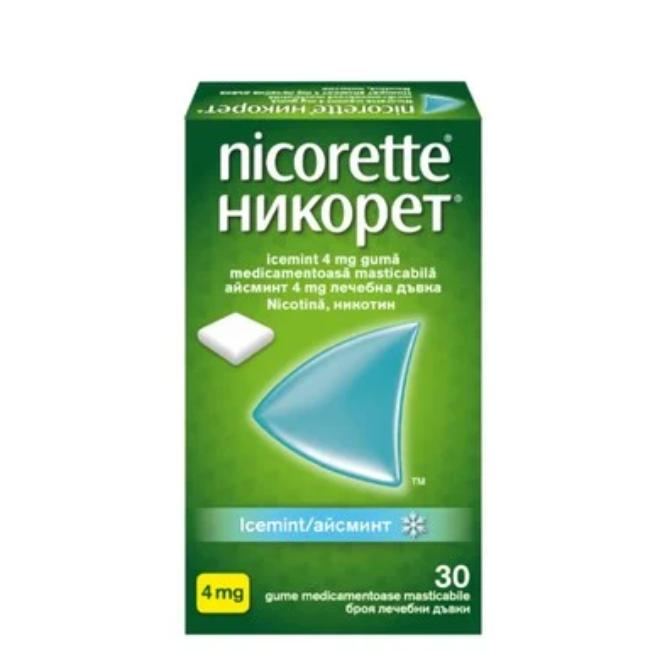
NICORETTE Ice Mint Nicotine Gum 4 mg x 30
Nicorette Ice Mint
doctor or pharmacist. This includes any possible side effects not listed in this leaflet. You can also report side effects directly via the national reporting system at: Bulgarian Medicines Agency, Damyan Gruev Str., 81303 Sofia, Tel.: +359 2 8903417, Website: www.bda.bg
By reporting side effects, you can help provide more information about the safety of this medicine.
5. How to store Nicorette Icemint Keep out of the reach of children.
Do not use Nicorette Ice Mint after the expiry date which is stated on the carton and blister after „EXP“. The expiry date refers to the last day of that month.
Store below 25°C, in the original packaging, in order to protect from light.
Do not throw away any medicines via wastewater or household waste. Ask your pharmacist how to dispose of medicines you no longer use. This will help to protect the environment.
6. Contents of the pack and other information What Nicorette Icemint contains Nicorette Icemint 4 mg: The active substance is nicotine. One medicated gum contains 4 mg nicotine as nicotine resinate.
The other ingredients are: CoreGum baseXylitolPeppermint oilSodium carbonate anhydrousAcesulfame potassiumLevomentholMagnesium oxide yellowQuinoline yellow E104 A1 varnishInner film: Winterfresh RDEA-149 flavor (contains: polyisobutylene, butyl rubber, terpene resin, polyvinyl acetate, polyethylene, paraffin wax, glycerol esters of fatty acids, calcium carbonate, butylated hydroxytoluene E321), hypromellose, sucralose, polysorbate 80;Outer film: xylitol, pregelatinized starch, titanium dioxide (E171), Winterfresh RDEA-149 flavor (contains: polyisobutylene, butyl rubber, terpene resin, polyvinyl acetate, polyethylene, paraffin wax, glycerol esters of fatty acids, calcium carbonate, butylated hydroxytoluene E321), carnauba wax, quinoline yellow E104 Al lake.
What Nicorette Icemint looks like and what the package contains Film-coated gum, white to light yellowish square medicated gum, with mint flavor, size 15x15x6 mm
The product is supplied in cardboard boxes with PVC-PVDC/A1 blisters.
4 mg: 12 pcs., 15 pcs., 24 pcs., 30 pcs., 48 pcs., 90 pcs., 105 pcs., 204 pcs. and 210 pcs. chewing gums in a blister pack (blisters of 12 or 15 pcs.) and a leaflet in a cardboard box.
Marketing Authorization Holder and Manufacturer McNeil AB
Sweden
Nicorette belongs to a group of medicines called nicotine replacement therapy (NRT). It is used to relieve nicotine cravings and withdrawal symptoms when you are trying to stop smoking; It can also be used to relieve nicotine cravings and withdrawal symptoms when you cannot smoke, e.g. in places where smoking is prohibited; It can also be used to reduce the number of cigarettes you smoke while you are trying to stop smoking.
When you suddenly stop smoking, your body experiences various forms of discomfort, known as withdrawal syndrome. With the help of Nicorette Ice Mint, you can avoid or at least reduce this discomfort by providing your body with small amounts of nicotine during the transition period. When you chew Nicorette Ice Mint, the nicotine is slowly released and absorbed through the oral cavity. Unlike cigarettes, Nicorette Ice Mint does not contain harmful tar or carbon monoxide.
When used according to dosage recommendations, nicotine gum has been shown to help control weight gain during smoking cessation. The gum contains a number of ingredients that are recognized to have teeth whitening properties.
Dosage and administration:
The dosage of the gum should be chosen according to your nicotine dependence. If you have smoked more than 20 cigarettes a day or if you have not previously achieved success with Nicorette Ice Mint Medicated Gum 2 mg, you should choose 4 mg. In other cases, 2 mg should be used.
At the beginning of treatment, one gum can be taken every hour or every 2 hours. In most cases, 8-12 gums per day are sufficient. More than 24 gums per day should not be used.
Smoking cessation: The treatment period is individual. Normally, treatment should last at least 3 months. The nicotine dose is gradually reduced. Treatment should be discontinued when the dose is reduced to 1-2 gums per day. Regular use of Nicorette Ice Mint gum for more than 1 year is generally not recommended. However, some former smokers may need longer treatment to prevent them from smoking again. Unused gums should be kept, as the urge to smoke may arise suddenly.
Smoking reduction: Nicorette Acemint gum is used between smoking periods to prolong the smoke-free intervals as much as possible. If after 6 weeks a reduction in the number of cigarettes smoked per day is not achieved, professional help should be sought. Attempts to quit smoking should be made when the smoker feels ready, but in any case no later than 6 months after starting treatment. If it is not possible to make a serious attempt to quit smoking by 9 months after starting treatment, professional help should be sought. Regular use of Nicorette Acemint gum for more than 1 year is generally not recommended. However, some former smokers may need longer treatment to prevent them from smoking again. Unused gum should be kept, as the urge to smoke may arise suddenly.
Ingredients:
The active substance is: nicotine resinate-complex 20% – 20 mg, equivalent to 4 mg nicotine.
NICORETTE medicated chewing gum 4 mg * 30 Leaflet: consumer information Nicorette Icemint 4 mg medicated chewing gum Nicotine
Read all of this leaflet carefully before you start taking this medicine because it contains important information for you. Always use this medicine exactly as described in this leaflet or as your doctor or pharmacist has told you. Keep this leaflet. You may need to read it again. If you need further information or advice, ask your pharmacist. If you get any side effects, tell your doctor or pharmacist. This includes any possible side effects not listed in this leaflet. See section 4. If you do not feel better within 3 months or your condition gets worse, you should seek medical advice. What this leaflet contains: 1. What Nicorette Ice Mint is and what it is used for 2. What you need to know before you use Nicorette Ice Mint 3. How to use Nicorette Ice Mint 4. Possible side effects 5. How to store Nicorette Ice Mint 6. Contents of the pack and other information
1. What is Nicorette Icemint and what is it used for? Nicorette gum is used in the treatment of nicotine addiction by satisfying nicotine cravings and relieving withdrawal symptoms that occur after trying to stop smoking:
treats smoking addiction in smokers who want to stop smoking; helps smokers with temporary abstinence when smoking cigarettes is impossible or undesirable; helps to reduce smoking in smokers who cannot or do not want to stop smoking Advice and support usually increase the rate of success. 2. What you need to know before you use Nicorette Icemint Do not use Nicorette Icemint medicated gum if you are allergic to nicotine or any of the other ingredients of this medicine (listed in section 6). Warnings and precautions Before treatment with Nicorette Icemint, tell your doctor if:
you have recently had a serious cardiovascular disease such as a myocardial infarction or a cerebrovascular accident; you have chest pain or this pain becomes worse, including Prinzmetal's angina, severe cardiac arrhythmia; you have uncontrolled high blood pressure; you have a stomach or duodenal ulcer; you have oesophagitis; you have an overactive thyroid gland; you have diabetes treated with insulin (you may need a lower dose of insulin after you stop smoking); you have a tumor of the adrenal glands (phaeochromocytoma - your doctor will need to tell you); you have severe kidney disease or moderate to severe liver disease; you are under 18 years of age. Smokers who wear dentures may have difficulty chewing Nicorette Ice Mint medicated gum, as it can stick to the dentures, and in very rare cases it can damage them.
Danger to children: Doses of nicotine tolerated by smokers can cause severe toxicity in children, which can be fatal. Nicotine-containing products should not be left where they can be touched or ingested by children.
A transfer of addiction to chewing gum may occur, but at the same time it is not as harmful and is easier to break than an addiction to smoking.
The benefits associated with quitting smoking outweigh any risks associated with the proper use of nicotine replacement therapy (NRT).
This medicine contains less than 1 mmol (23 mg) sodium per gum, i.e. essentially „sodium-free“.
This medicine contains traces of alcohol (ethanol) in each gum. The small amount of alcohol in this medicine will not have any noticeable effects. This medicine contains traces of butylated hydroxytoluene (E321). Xylitol may have a laxative effect. Caloric value: 2.4 kcal/g xylitol.
Keep out of reach of children. In case of overdose, contact an ambulance immediately.
Other medicines and Nicorette Acemint Smoking can change the way your body responds to treatment with some medicines. Therefore, when you stop smoking (with or without the help of nicotine replacement therapy), the dosage of the medicines you are taking may change. No clinically significant interactions between nicotine replacement therapy and other medicines have been identified. However, you should tell your doctor if you are being treated with adenosine, because nicotine may enhance the haemodynamic effects of adenosine, e.g. increase blood pressure and heart rate, and the response to pain (angina-type chest pain) caused by taking adenosine. Please tell your doctor or pharmacist if you are taking or have recently taken any other medicines, including medicines obtained without a prescription. Stopping smoking may require a change in the doses of the medicines you are taking.
Pregnancy, breast-feeding and fertility If you are pregnant or breast-feeding, think you may be pregnant or are planning to have a baby, ask your doctor or pharmacist for advice before using this medicine. Smoking during pregnancy is associated with risks such as intrauterine growth retardation, premature birth or stillbirth. Stopping smoking is the single most effective intervention to improve the health of both the pregnant smoker and her child. The earlier nicotine withdrawal occurs, the better. Nicotine passes into the foetus and affects its breathing and circulation. The effect on circulation is dose-dependent. Therefore, pregnant smokers are always advised to stop smoking without using nicotine replacement therapy. The risk associated with continuing to smoke may be more dangerous to the foetus than using nicotine replacement products as part of a supervised smoking cessation programme. The use of medicated gum by an addicted pregnant smoker should only be started after discussion with a doctor.
Nicotine passes freely into breast milk in amounts that may affect the infant even at therapeutic doses. Therefore, medicated gum should be avoided during breastfeeding. If the mother is unable to stop smoking, use of medicated gum by a nursing smoker should only be initiated after discussion with a doctor.
FertilityIn women, smoking delays the time to conception, reduces the rate of successful in-vitro fertilization, and significantly increases the risk of infertility.In men, smoking reduces sperm production, increases oxidative stress, and DNA damage. Sperm from smokers have reduced fertility. The specific contribution of nicotine to these effects in humans is unknown.
Driving and using machines Nicorette Ice Mint medicated gum has no or negligible influence on the ability to drive and use machines.
3. How to use Nicorette Acemint Always take Nicorette Acemint exactly as described in this leaflet. You should always check with your doctor or pharmacist if you are not sure.
Each medicated gum should be chewed slowly for approximately 30 minutes, with breaks. Nicotine use should be temporarily discontinued if symptoms of nicotine overuse occur. If symptoms of nicotine overuse persist, use should be reduced either by reducing the frequency or by using a lower dose.
Children and adolescents: People under the age of 18 should not use medicated gum without the advice of a doctor. There is a lack of controlled clinical data to support the use of medicated gum in adolescents under the age of 18.
What dose of Nicorette Icemint medicated gum should you use: Nicorette Icemint 2 mg medicated gum if you smoke less than 20 cigarettes a day or smoke less than 30 minutes after waking up; Nicorette Icemint 4 mg medicated gum if you smoke more than 20 cigarettes a day or have not been able to stop smoking after using Nicorette Icemint 2 mg. Do not use more than the recommended dose.
How to use Nicorette Icemint Chew a piece of medicated gum when you feel the urge to smoke. The gum is chewed to release nicotine, which will be absorbed through the lining of the mouth. Nicotine swallowed with saliva is not beneficial and in large quantities can irritate the throat or stomach, causing hiccups. To avoid this, chew slowly until you feel a strong taste, then stop. In this case, push the gum to the cheek with your tongue and hold it there until the feeling disappears. The chewing/resting cycle will repeat for 30 minutes. When the gum no longer has a minty taste, please discard the used gum in the blister cavity.
How many Nicorette Ice Mints can be used and for how long? Use one gum at a time. To ensure complete success of the treatment, stop smoking completely. The number of gums you can use per day depends on the nicotine craving you experience, but the average dose is 8-12 gums per day. Do not exceed 24 gums per day. This dose will be used for a period of up to 3 months, when you need to lose your smoking habits. It is generally not recommended to use this type of treatment for more than 12 months. However, some smokers need longer treatment to avoid smoking relapse. Keep the medicated gum handy if you feel the need to satisfy your nicotine craving.
If you use more Nicorette Acemint than you should Symptoms of overdose are similar to those of acute nicotine intoxication and include nausea, vomiting, increased salivation, abdominal pain, diarrhea, sweating, headache, dizziness, hearing loss and fatigue. In high doses, these symptoms may be followed by low blood pressure, weak, irregular heartbeat, difficulty breathing, severe asthenia, circulatory collapse and generalized seizures.
Nicotine doses tolerated by adult smokers during treatment can cause severe symptoms of poisoning in young children and may be fatal for them. Suspected nicotine poisoning in young children should be considered an emergency and should be treated immediately. If you have used more pieces or a child has chewed or swallowed a piece of medicated gum, please tell your doctor immediately or go to the nearest hospital immediately, taking the medicine pack with you.
The risk of intoxication after swallowing gum is very low because the absorption of nicotine from unchewed gum is slow and incomplete.
If you have any further questions on the use of this medicine, ask your doctor or pharmacist.
4. Possible side effects Like all medicines, Nicorette Acemint can cause side effects, although not everybody gets them.
Effects of smoking cessation Regardless of the methods used, various symptoms are known to be associated with cessation of habitual tobacco use. These symptoms include emotional or cognitive effects, such as dysphoria or depressed mood; insomnia; irritability, frustration or anger; anxiety; difficulty concentrating and restlessness or impatience. Physical effects may also be observed, such as slowed heart rate; increased appetite or weight gain, dizziness or presyncopal symptoms, cough, constipation, bleeding gums or aphthous ulcers or nasopharyngitis. In addition, and of clinical significance, the strong craving for nicotine may lead to strong urges to smoke. Most of the adverse drug reactions reported by patients occurred during the early phase of treatment and were mostly dose-dependent.
Irritation in the mouth and throat may occur, but most patients adapt during use.
Allergic reactions (including symptoms of anaphylaxis) occur rarely when using Nicorette Ice Mint medicated gum.
Chewing gum can stick to teeth and cause dental problems.
The following side effects have been reported with the use of Nicorette Acemint 2 mg and 4 mg:
Common (may affect up to 1 in 10 people): diarrhoea Uncommon (may affect up to 1 in 100 people): palpitations, fast heartbeat, belching, inflammation of the tongue, blisters on the oral mucosa and exfoliation, numbness of the tongue and oral mucosa, constant fatigue, chest pain and discomfort, malaise, jaw pain, abnormal dreams, spasm of the airways, changes in voice, shortness of breath, nasal congestion, oropharyngeal pain, sneezing, tightness in the throat, excessive sweating, itching, rash, with or without itching, flushing of the face, high blood pressure. Rare (may affect up to 1 in 1,000 people): difficulty swallowing, reduced sensation or sensitivity, especially in the mouth, nausea. Not known (frequency cannot be estimated from the available data): blurred vision vision, watery eyes, dry throat, gastrointestinal discomfort, lip pain, severe allergic reaction, jaw stiffness and jaw pain, severe allergic reaction with swelling of the face and mouth, skin redness. Reporting of side effects If you get any side effects, tell your doctor.
Няма добавен състав за този продукт.
Няма добавен начин на употреба за този продукт.
There are no added contraindications to this product.
Customer Reviews
0 published reviews
There are no published reviews about this product yet.
Add a review
Your email address will not be published.
Полетата отбелязани със звездичка са задължителни.