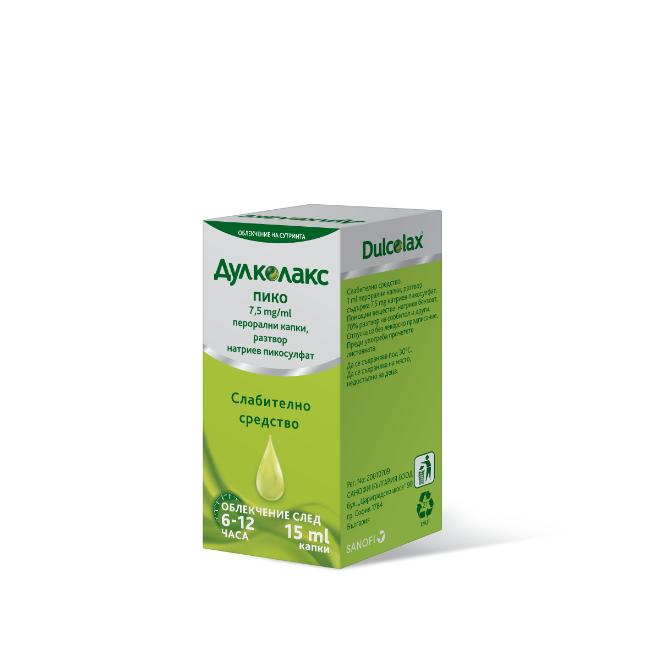
Dulcolax Pico Drops with laxative effect 15 ml Sanofi
DULCOLAX PICO oral drops, solution 7.5 mg / ml 15 ml SANOFI PACKAGE LEAFLET: INFORMATION FOR THE USER DULCOLAX PICO 7.5 mg/ml drops oral solution Sodium picosulphate DULCOLAX® PICO 7.5 mg/ml oral drops, solution Sodium picosulphate Read all of this leaflet carefully before you start taking this medicine because it contains important information for you.
This medicine is available without a prescription. Always take this medicine exactly as described in this leaflet or as your doctor or pharmacist has told you.
Keep this leaflet. You may need to read it again.
If you have any further questions, ask your pharmacist.
If you get any side effects, please tell your doctor or pharmacist. This includes any possible side effects not listed in this leaflet. See section 4.
If you do not feel better or your condition worsens, you should seek medical attention.
What this leaflet contains:
1. What DULCOLAX PICO is and what it is used for 2. What you need to know before you take DULCOLAX PICO 3. How to take DULCOLAX PICO 4. Possible side effects 5. How to store DULCOLAX PICO 6. Contents of the pack and other information
1. What DULCOLAX PICO is and what it is used for
DULCOLAX PICO is a topical laxative that stimulates intestinal peristalsis and softens stools.
As a laxative that exerts its therapeutic effect on the large intestine, DULCOLAX PICO specifically stimulates the natural process of emptying the lower gastrointestinal tract. Therefore, DULCOLAX PICO does not affect digestion, nor does it lead to the accumulation of calories or other nutrients in the small intestine.
DULCOLAX PICO is used for
use in patients with constipation (difficulty defecation),
in conditions where defecation facilitation is required.
2. What you need to know before you take DULCOLAX PICO Do not take DULCOLAX PICO
if you are allergic to sodium picosulfate or any of the other ingredients of this medicine (listed in section 6).
if you have intestinal obstruction (temporary inhibition of intestinal peristalsis) or intestinal obstruction;
if you have severe abdominal pain and/or are in a state of acute abdominal pain accompanied by fever (e.g. appendicitis), potentially associated with nausea and vomiting
if you have acute inflammatory bowel disease;
if you are severely dehydrated;
if you have rare congenital diseases that may lead to incompatibility with some of the excipients of the medicinal product (see section „DULCOLAX PICO contains sorbitol“).
Warnings and precautions
Talk to your doctor or pharmacist before taking DULCOLAX PICO.
If you need laxatives every day or for a long period of time - you should contact your doctor to determine the cause of constipation, as prolonged use of high doses can lead to a disruption of water and electrolyte balance and a decrease in the level of potassium in the blood (hypokalemia).
There have been reports of dizziness and nausea in patients taking DULCOLAX PICO. These events may be related to constipation (contractions during bowel movements, abdominal pain), but not necessarily to the administration of sodium picosulfate itself.
Children should not take DULCOLAX PICO without the advice of a doctor.
Other medicines and DULCOLAX PICO
Tell your doctor or pharmacist if you are taking, have recently taken or might take any other medicines.
When taking high doses of DULCOLAX PICO, concomitant use of diuretics (water tablets) or steroids may increase the risk of electrolyte imbalance. Electrolyte imbalance may lead to increased sensitivity to cardiac glycosides (a group of medicinal products used in heart failure and irregular heart rhythm, e.g. digoxin).
Concomitant use with antibiotics (medicines to treat bacterial infections) may reduce the laxative effect of DULCOLAX PICO.
Pregnancy, breastfeeding and fertility
If you are pregnant or breast-feeding, think you may be pregnant or are planning to become pregnant, ask your doctor or pharmacist for advice before using this medicine.
Like all medicinal products, DULCOLAX PICO should be taken during pregnancy only on the advice of a doctor.
DULCOLAX PICO can be used during breastfeeding.
Driving and using machines
No studies have been conducted on the effect of DULCOLAX PICO on the ability to drive and use machines.
However, patients should be informed that due to a reaction of the autonomic nervous system (e.g. abdominal spasm), they may experience dizziness or nausea. If patients experience abdominal spasm, they should avoid potentially hazardous activities, such as driving and operating machinery.
DULCOLAX PICO contains sorbitol
1 ml of the drops contain 0.45 g of sorbitol, which corresponds to 0.6 g of sorbitol in the maximum recommended daily dose for the treatment of adults and children over 10 years of age. Contains 43 mg of sorbitol per drop, which corresponds to 643.7 mg / ml.
Sorbitol is a source of fructose. If you have been told by your doctor that you (or your child) have an intolerance to some sugars, or if you (or your child) have been diagnosed with hereditary problems of fructose intolerance (which means that the body is unable to break down fructose), you should consult your doctor before taking this medicine.
3. How to take DULCOLAX PICO
Always take this medicine exactly as described in this leaflet or as your doctor or pharmacist has told you. If you are not sure, ask your doctor or pharmacist.
The recommended dose is:
Adults take 10-20 drops (5-10 mg) daily. Start with 10 drops. The dose can be increased to a maximum of 20 drops. Do not exceed the maximum daily dose of 20 drops.
Children and adolescents
Children over 10 years old take 10-20 drops (5-10 mg) daily. Start with 10 drops. The dose can be increased to a maximum of 20 drops. Do not exceed the maximum daily dose of 20 drops.
Children aged 4-10 years take 5-10 drops (2.5-5 mg) daily. Start with 5 drops. The dose can be increased to a maximum of 10 drops. Do not exceed the maximum daily dose of 10 drops.
For children under 4 years of age, the recommended daily dose is 1 drop per 2 kilograms of body weight.
Method of administration
You should take DULCOLAX PICO in the evening to cause a bowel movement the next morning. The duration of action is usually 6-12 hours after taking it.
If you take or use more DULCOLAX PICO than you should
If you take more DULCOLAX PICO than you should, you should seek advice from your doctor or pharmacist.
If high doses are taken, watery stools (diarrhea), abdominal cramps, and loss of fluids, potassium, and other electrolytes may occur.
In addition, cases of damage to the inner lining of the colon (colonic mucosal ischemia) have been reported when DULCOLAX PICO has been taken in doses significantly higher than those recommended for the treatment of constipation.
Chronic overdose with DULCOLAX PICO, as with all laxatives, can cause chronic diarrhea, abdominal pain, low blood potassium, secondary hyperaldosteronism (increased production of the hormone aldosterone, which controls the levels of sodium and potassium in the blood) and kidney stones. Cases of renal tubular damage (a type of kidney disorder), metabolic alkalosis (a disorder of acid-base balance) and muscle weakness due to low blood potassium have been described as a result of chronic laxative abuse.
If you forget to take DULCOLAX PICO
If you forget to take DULCOLAX PICO, take it as soon as you remember, but do not take a double dose to make up for the missed dose.
If you stop taking DULCOLAX PICO
DULCOLAX PICO should be taken only when needed, and, if necessary, its intake should be discontinued.
If you have any further questions on the use of this medicinal product, please ask your doctor or pharmacist.
4. Possible side effects
Like all medicines, this medicine can cause side effects, although not everybody gets them.
Very common (may affect more than 1 in 10 people)
diarrhea
Common (may affect up to 1 in 10 people)
abdominal cramps
abdominal pain
stomach discomfort
Uncommon (may affect up to 1 in 100 people)
vomiting
nausea
dizziness
Not known (frequency cannot be estimated from the available data)
skin reactions such as
rapid swelling of the skin or mucous membrane, which may cause difficulty in
breathing (angioedema) o drug rash (rash or skin reaction caused by a medicine) rash
itching
fainting
Dizziness and fainting occurring after taking sodium picosulfate may be due to constipation (pain during defecation, abdominal pain). .
Reporting side effects
If you get any side effects, please tell your doctor, pharmacist or nurse. This includes any possible side effects not listed in this leaflet. You can also report side effects directly to the Executive Agency for Medicines, Damyan Gruev Str., 81303 Sofia.
By reporting side effects, you can help provide more information about the safety of this medicine.
5. How to store DUCOLAX PICO
Store below 30°C. Keep out of the reach of children.
Do not use this medicine after the expiry date which is stated on the carton.
Do not throw away medicines via wastewater or household waste. Ask your pharmacist how to dispose of medicines you no longer use. These measures will help protect the environment.
6. Contents of the pack and other information What DULCOLAX PICO contains
The active substance is 7.5 mg sodium picosulfate per 1 ml of solution (=15 drops).
The excipients are sodium benzoate, sorbitol (E420), sodium citrate dihydrate, citric acid monohydrate, purified water.
What DULCOLAX PICO looks like and contents of the pack
Polyethylene bottle of 15 or 30 ml, placed in a cardboard box.
Not all packaging types can be released for sale
Marketing Authorisation Holder and Manufacturer Marketing Authorisation Holder:
SANOFI BULGARIA EOOD, Bulgaria
Manufacturer:
Istituto de Angeli Srl, Italy
Text update date: 07/2020
The following information is intended for medical or healthcare professionals only:
Treatment in case of overdose: After taking the oral forms of DULCOLAX PICO, absorption can be minimized or prevented by inducing vomiting or gastric lavage. Fluid intake and correction of electrolyte imbalance may be necessary. This is especially important in elderly patients and adolescents.
Administering an antispasmodic can help the process.
Няма добавен състав за този продукт.
Няма добавен начин на употреба за този продукт.
There are no added contraindications to this product.
Customer Reviews
0 published reviews
There are no published reviews about this product yet.
Add a review
Your email address will not be published.
Полетата отбелязани със звездичка са задължителни.