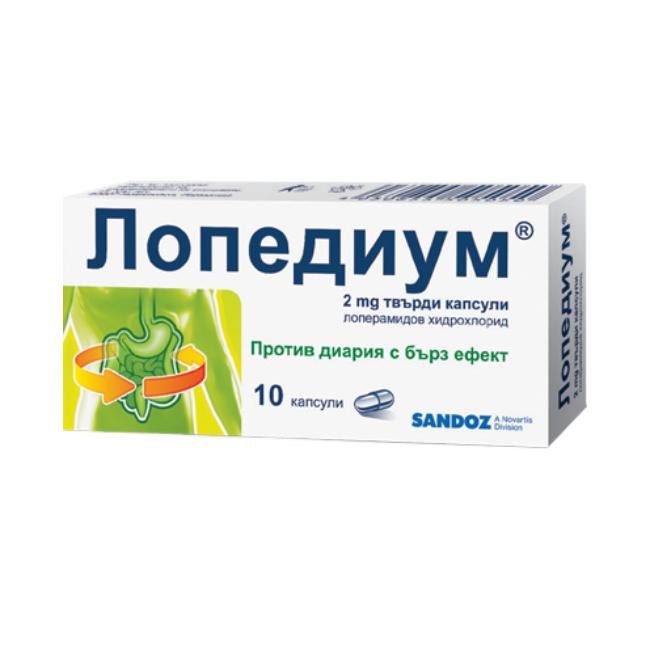
Lopedium 2 mg anti-diarrhea x10 capsules Sandoz
LOPEDIUM capsules 2 mg * 10 Leaflet: information for the user Lopedium 2 mg hard capsules Lopedium 2 mg hard capsules loperamide hydrochloride Read all of this leaflet carefully before you start taking this medicine because it contains important information for you.
Keep this leaflet. You may need to read it again.
If you need further information or advice, ask your pharmacist.
If you get any side effects, talk to your doctor or pharmacist or nurse. This includes any possible side effects not listed in this leaflet. See section 4.
If you do not feel better after 2-3 days or your condition worsens, you should seek medical attention.
What this leaflet contains
1. What Lopedium is and what it is used for 2. What you need to know before you take Lopedium 3. How to take Lopedium 4. Possible side effects 5. How to store Lopedium 6. Contents of the pack and other information
1. What Lopedium is and what it is used for
Lopedium is used for the symptomatic treatment of diarrhea when it is not possible to treat the cause of the diarrhea directly. Long-term use of Lopedium requires medical supervision.
2. What you need to know before you take Lopedium Do not take Lopedium
if you are allergic to loperamide hydrochloride or any of the other ingredients of this medicine (listed in section 6);
in conditions where slowing of peristalsis and bowel function should be avoided due to the risk of serious consequences. Lopedium should be discontinued as soon as constipation, abdominal heaviness or intestinal obstruction occurs;
in children under 2 years of age;
Treatment with Lopedium should not be started in cases of:
a disorder accompanied by fever and stools with blood and mucus (acute dysentery);
acute attack of ulcerative colitis (ulcerative inflammation of the colon); bacterial inflammation of the intestine caused by intestinal bacteria that pass through the intestinal wall (e.g. salmonella, shigella and campylobacter).
diarrhea that occurred after taking broad-spectrum antibiotics (pseudomembranous colitis).
Warnings and precautions
In certain diseases or conditions, Lopedium can only be used after consulting your doctor. This also applies if you suffer from the above-mentioned diseases.
Talk to your doctor or pharmacist before taking Lopedium:
if the cause of your diarrhoea cannot be controlled. Lopedium stops diarrhoea but does not eliminate its cause.
if you suffer or have suffered from liver disease, as the metabolism of loperamide hydrochloride may be slowed down in the presence of severe liver disease. In these cases, you should only use Lopedium after consulting a doctor. If you suffer from liver disease, you should use Lopedium with caution, as this may lead to possible damage to the nervous system.
in case of loss of large amounts of fluids and electrolytes, especially in children. Dry mouth can be a sign of dehydration. In case of dehydration, the child may feel dizzy and start vomiting. The use of appropriate fluid and salt (electrolyte) replacement therapy is the most important measure in the presence of diarrhea. Lopedium should not be given to children between the ages of 2 and 6 years without a doctor's prescription and supervision.
if you are an AIDS patient and are being treated with Lopedium for diarrhea. At the earliest appearance of swelling and heaviness in the abdominal area, Lopedium should be stopped and a doctor should be consulted. Isolated cases of toxic megacolon have been reported in patients with AIDS and infectious inflammation of the colon (colitis), both viral and bacterial in origin, who were treated with loperamide hydrochloride.
Do not take this product for anything other than what it is intended for (see section 1) and never take more than the recommended amount (see section 3). There have been reports of serious heart problems (symptoms of which include a fast or irregular heartbeat) in patients who have taken too much loperamide, the active ingredient in Lopedium.
Stop taking Lopedium:
if there is no improvement within 48 hours of taking the medicine and inform your doctor,
when stools become harder or when there is no bowel movement for more than 12 hours;
when constipation occurs;
if you have swelling and heaviness in the abdomen, abdominal pain, cramps, vomiting, constipation and lack of gas (a sign of intestinal obstruction).
Do not use Lopedium for more than 14 days without consulting a doctor.
Lopedium contains lactose. If you have been told by your doctor that you have an intolerance to some sugars, contact your doctor before taking this medicinal product.
Children and adolescents
Children under 2 years of age should not be treated with medicines containing loperamide hydrochloride, such as Lopedium. The dosage for children aged 2 to 6 years should be adjusted to their body weight. Lopedium capsules are not suitable for children in this age group due to the high content of the active ingredient. Other prescription formulations are available for this purpose.
Other medicines and Lopedium
Tell your doctor or pharmacist if you are taking or have recently taken any other medicines.
Loperamide hydrochloride blood levels may increase when administered concomitantly with:
drugs that inhibit the body's own P-glycoprotein (e.g. quinidine, ritonavir, itraconazole and ketoconazole)
blood lipid-lowering drugs (gemfibrozil)
drugs that suppress the activity of the stomach and intestines.
Taking quinidine, verapamil or ketoconazole simultaneously with Lopedium causes respiratory depression.
It is possible that drugs that accelerate the transport of food or intestinal contents in the gastrointestinal tract may reduce the effect of loperamide.
Concomitant use of Lopedium with oral desmopressin (a synthetic analogue of the hormone vasopressin to suppress urination, used in the so-called diabetes insipidus) leads to an increased concentration of desmopressin in the blood. The dose of desmopressin should be reduced, as its effect may become too strong.
Pregnancy and breastfeeding
If you are pregnant or breast-feeding, think you may be pregnant or are planning to have a baby, ask your doctor or pharmacist for advice before taking this medicine.
Pregnancy
Taking Lopedium during pregnancy is not recommended. Women who are pregnant or breastfeeding should consult their doctor for appropriate treatment.
Breastfeeding
Do not take Lopedium if you are breast-feeding, as small amounts of loperamide may pass into breast milk. Ask your doctor for appropriate treatment.
Driving and using machines
Diarrhea treated with Lopedium may cause fatigue, dizziness, or drowsiness. Therefore, caution is recommended when driving or operating machinery.
This medicine contains less than 1 mmol sodium (23 mg), that is to say essentially 'sodium-free'.
3. How to take Lopedium
Always take this medicine exactly as your doctor or pharmacist has told you. If you are not sure, ask your doctor or pharmacist.
The following dosage is recommended unless your doctor has prescribed Lopedium in a different dosage regimen. You must follow the instructions for use otherwise Lopedium will not work properly.
Adults
Acute diarrhea
The recommended initial dose is 2 capsules (equivalent to 4 mg loperamide hydrochloride), followed by 1 capsule (2 mg) after each subsequent loose stool.
Chronic diarrhea
The recommended starting dose is 2 capsules (4 mg); the starting dose is adjusted until 1-2 hard stools are achieved per day. This is usually achieved with a maintenance dose of 1-6 capsules (2 mg - 12 mg) of loperamide hydrochloride per day. The maximum dose for acute and chronic diarrhoea is 8 capsules (corresponding to 16 mg of loperamide hydrochloride) per day and should not be exceeded.
Children and adolescents aged 6 to 17 years
Acute diarrhea
The recommended initial dose is 1 capsule (corresponding to 2 mg loperamide hydrochloride), followed by 1 capsule (2 mg) after each subsequent loose stool.
Chronic diarrhea
The recommended starting dose is 1 capsule (2 mg); the starting dose is adjusted until 1-2 hard stools per day are achieved. This is usually achieved with a maintenance dose of 1-6 capsules (2 mg - 12 mg) of loperamide hydrochloride per day.
The maximum daily dose for acute and chronic diarrhoea is 3 capsules (corresponding to 6 mg loperamide hydrochloride) per 20 kg body weight and should not be exceeded.
The total daily dose should not exceed a maximum of 8 capsules (corresponding to 16 mg loperamide hydrochloride) per day.
Children under 2 years old
Loperamide hydrochloride should not be used in children under 2 years of age.
Method of administration
For oral administration.
The hard gelatin capsules are taken without chewing, together with a little water.
If clinical improvement is not observed within 48 hours after starting treatment for acute diarrhea, Lopedium should be discontinued and a doctor should be consulted.
Lopedium should not be used for more than 4 weeks without medical supervision. In case of diarrhea, measures to restore fluids and electrolytes should be taken as the most important treatment method, especially in children.
If you take more Lopedium than you should
If you take too much Lopedium, contact a doctor or hospital for advice immediately. Symptoms may include: rapid heartbeat, irregular heartbeat, changes in heartbeat (these symptoms can have potentially serious, life-threatening consequences), muscle stiffness, uncoordinated movements, drowsiness, difficulty urinating or shortness of breath, dry mouth, abdominal pain and cramps, nausea, vomiting, intestinal obstruction (ileus), slowed thinking and emotions (stupor), narrow pupils.
Children react more strongly to large amounts of Lopedium than adults. If a child takes too much of the product or shows any of the symptoms described above, call a doctor immediately. Children are more sensitive to the effects on the central nervous system than adults.
If symptoms of overdose occur, medical advice should be sought. Treatment is aimed at managing the symptoms of overdose, and the existing antidote naloxone may be used at your discretion.
Note to the doctor
The effect of loperamide is longer than that of naloxone, which requires repeated administration of naloxone. The patient should be carefully observed for at least 48 hours to detect possible central nervous system depression. If it is necessary to remove the remains of the active ingredient from the stomach, gastric lavage is performed.
If you have any further questions on the use of this medicine, ask your doctor or pharmacist.
If you forget to take Lopedium
Do not take a double dose to make up for a forgotten dose.
4. Possible side effects
Like all medicines, this medicine can cause side effects, although not everybody gets them.
The following adverse drug reactions have been reported with the use of loperamide hydrochloride either in clinical trials or in the post-marketing period.
Common (may affect up to 1 in 10 people)
headache, dizziness, nausea, constipation, flatulence.
Uncommon (may affect up to 1 in 100 people)
pain in the upper and lower abdomen (including cramps), abdominal complaints, dry mouth, vomiting, indigestion (dyspepsia), skin rash, drowsiness.
Rare (may affect up to 1 in 1,000 people)
heaviness and swelling in the abdominal area, narrow pupils, allergic reaction, including severe allergic reaction causing difficulty breathing or dizziness (anaphylactic shock), loss of consciousness, slowed thinking and emotions (stupor), decreased level of consciousness, increased muscle tone, impaired coordination
Not known: frequency cannot be estimated from the available data
intestinal obstruction (ileus, paralytic ileus); unusual swelling of the large intestine as a complication of so-called chronic inflammatory bowel disease (megacolon, toxic megacolon); burning or painful tongue (glossodynia); severe skin disease with blistering (such as Stevens-Johnson syndrome, toxic epidermal necrolysis, erythema multiforme); swelling of the tongue or mucous membranes due to fluid retention in the tissues (angioedema); hives, itching, urinary retention; fatigue.
Reporting side effects
If you get any side effects, tell your doctor, pharmacist or nurse. This includes any possible side effects not listed in this leaflet. You can also report side effects directly via the national reporting system at the Bulgarian Medicines Agency, 8 Damyan Gruev Str., 1303 Sofia. By reporting side effects, you can help to provide more information on the safety of this medicine.
5. How to store Lopedium
Keep out of reach of children. Store in the carton, in a dry place.
Do not use this medicine after the expiry date which is stated on the packaging. The expiry date refers to the last day of that month. Do not throw away any medicines via wastewater or household waste. Ask your pharmacist how to throw away medicines you no longer use. These measures will help to protect the environment.
6. Contents of the pack and other information What Lopedium contains
The active substance is loperamide hydrochloride. Each hard gelatin capsule contains 2 mg loperamide hydrochloride. The other ingredients are: gelatin, lactose monohydrate, magnesium stearate, corn starch, talc, dyes - iron oxide, patent blue and titanium dioxide.
Advice for diabetics:
1 hard gelatin capsule contains 0.01 carbohydrate units.
What Lopedium looks like and contents of the pack
Original packaging containing 10 hard gelatin capsules, packed in PP/Alu or PVC/PVDC/Alu blisters.
Marketing Authorisation Holder
Hexal AG, Germany
Manufacturers
Salutas Pharma GmbH, Germany Lek SA, PolandS.C. Sandoz SRL, Romania
Няма добавен състав за този продукт.
Няма добавен начин на употреба за този продукт.
There are no added contraindications to this product.
Customer Reviews
0 published reviews
There are no published reviews about this product yet.
Add a review
Your email address will not be published.
Полетата отбелязани със звездичка са задължителни.